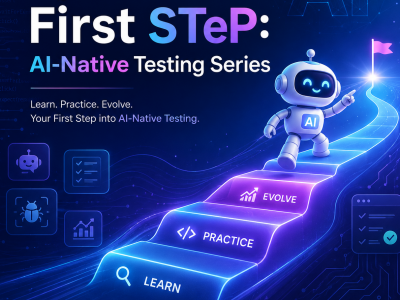
Test Automation Engineering: Selenium, Playwright & AI is a progressive three-part program that develops automation capability from foundational framework engineering to modern browser automation and AI-assisted workflows.
The program follows one central principle: the skills first practiced by hand become the judgment required to direct and review AI-generated automation. Learners do not simply learn how to produce scripts. They learn how to design maintainable automation, recognize failure patterns, evaluate generated code, and make responsible engineering decisions.
Part 1 — Test Automation Engineering with Selenium
The first part establishes the foundations of test automation engineering using Selenium WebDriver, Java, TestNG, Maven, GitHub, Selenium Grid, and Jenkins.
Learners create and organize browser tests, control execution with TestNG, apply data-driven testing, and build maintainable automation using the Page Object design pattern. They work with special web elements, tables, popups, iframes, keyboard actions, generated test data, and reusable data objects.
The course then moves into scalable execution through parallel testing, Selenium Grid, external configuration, command-line execution, GitHub integration, and Jenkins-based continuous testing.
Part 2 — Modern Web Automation with Playwright
The second part modernizes the learner’s automation approach using Playwright, TypeScript, and the Playwright Test runner.
Learners examine why older automation practices become unreliable on modern web applications and replace them with resilient locators, auto-waiting, web-first assertions, fixtures, browser-context isolation, reusable authentication state, network interception, deterministic mocking, trace-based debugging, and visual regression testing.
The course uses practical labs to develop the ability to identify hard waits, brittle selectors, stale-reference patterns, incomplete assertions, shared-state risks, and other common automation problems. The final module introduces the pilot-and-copilot model for reviewing AI-generated Playwright tests.
Part 3 — Advanced Practice: AI-Assisted Test Automation
The final part applies AI across the full automation lifecycle through 15 practical ways AI can assist test automation engineering.
Learners use AI to analyze interfaces, propose and evaluate locators, map manual tests into automation steps, generate UI and API scripts, build page objects, design test data, understand generated code, refactor safely, diagnose failures, improve waits and assertions, handle dynamic interfaces, stabilize flaky tests, and optimize regression scope.
Five governing foundations keep the engineer in control:
- The Copilot Model.
- The AI Output Annotation System.
- The Locator Hierarchy.
- Predictable AI Automation Failure Modes.
- Prompt Input Discipline.
AI supports generation and analysis, but the engineer remains responsible for scope, coverage, verification, architecture, and approval.
By completing the complete series, learners will be able to:
- Build maintainable Selenium automation frameworks.
- Apply TestNG, data-driven testing, Page Objects, parallel execution, and Selenium Grid.
- Integrate test automation with GitHub, Maven, Jenkins, and CI workflows.
- Write reliable Playwright tests using TypeScript.
- Use resilient locators, fixtures, session reuse, and browser-context isolation.
- Control and validate network behavior through interception and mocking.
- Diagnose failures using trace evidence and visual comparisons.
- Recognize brittle, incomplete, or misleading automation code.
- Direct AI across automation authoring, debugging, maintenance, and optimization.
- Review and correct AI-generated automation before it enters the codebase.
- Operate as the accountable engineer while using AI as a copilot.