
— Hung Nguyen, Creator of STeP at SOH
Here's something most people don't expect: as AI writes more code — faster than ever — the need for people who can tell whether that code actually works has grown, not shrunk. Every automation system needs to be built, tested, and maintained. Instead of replacing the need for software quality work, AI has multiplied it, because now there's more software, shipped faster, with less time for anyone to slow down and check it carefully.
Software testing — increasingly called Quality Engineering (QE) — is the profession responsible for answering one question before anyone else does: does this actually work, and can we trust it? That question hasn't gone away in the AI era. If anything, it's become more urgent, because AI can produce code (and tests, and decisions) that look right without being right.
Hospitals, banks, retailers, and logistics companies all now compete for QA talent the same way they compete for developers. This isn't a temporary boom — software is permanent economic infrastructure.
As AI accelerates how fast code gets written, the bottleneck has shifted to verification — having enough skilled people to review, validate, and catch what AI-generated code gets wrong. That bottleneck is your career opportunity.
You don't need a four-year computer science degree. You need to be detail-oriented, curious, and willing to think critically about software — then build technical skills on top of that foundation.
Healthcare, finance, government, retail, logistics — all of it runs on software now, and all of it needs people who can make sure that software is trustworthy.
Let's talk plainly about compensation — you deserve real numbers, not vague promises. The figures below reflect the US and Vietnam markets specifically, since those are the two we know most intimately. Every other country will have its own absolute numbers, though the same underlying shape tends to hold.
$48,000 – $55,000 / yr
$65,000 – $80,000 / yr
$75,000 – $105,000 / yr
$95,000 – $130,000 / yr
The US Bureau of Labor Statistics puts the national median at just over $100,000, with the top 10% earning above $165,000. Your skills — not just your job title — determine your ceiling.
QA/testing salaries range from roughly ₫7.5M to ₫55M per month, with Ho Chi Minh City and Hanoi paying the highest. Engineers who learn AI testing frameworks are already commanding a 30–50% premium over generalist testers.
Remote work for international clients adds another 40–60% on top of local rates for those who qualify. For new entrants who move quickly from foundational skills into automation and AI-assisted testing, total compensation increases of 50–100% within the first two years are not uncommon. — Hung
The US Bureau of Labor Statistics projects 15% job growth for software developers, QA analysts, and testers between 2024 and 2034 — "much faster than average" — with roughly 129,000 openings every year. But that growth isn't evenly distributed. It's concentrated in AI-native and AI-literate testing roles. The growth is real. It's just increasingly reserved for people who prepared for it.
2024–2034, much faster than average for all occupations
New roles plus people transitioning out of existing ones
US Bureau of Labor Statistics, Software QA Analysts & Testers
Typical comp increase in Vietnam within first 2 years for automation-literate testers
— based on Hung's direct experience with outsourced IT/software companies in Vietnam*
Forget the stereotype of someone just clicking buttons looking for bugs. Here's what a realistic day looks like for a tester working in 2026 — one where you supervise AI as much as you execute tests yourself.
Stand-up: what changed overnight, what the automated test suite caught while everyone was asleep. You review AI-generated test results and decide what's worth your attention today.
Some time goes to structured test cases. Some goes to exploratory testing — poking at the software the way a curious real user might, to find issues nobody thought to write a test case for. AI can't decide which unscripted human behaviors are worth testing for. That's your job.
You dig into a tricky bug with developers. You join a feature review. You review AI-generated code or test cases — because your job isn't just generating tests, it's judging whether the tests AI generated are actually any good.
Less time writing every test step by hand, more time directing AI agents, checking their output, and catching subtle mistakes that "look right" but aren't. You're the person making sure the AI doing the heavy lifting is actually getting it right.
You are the person in the room asking "but does it actually work?" — and increasingly, "can we trust what the AI just told us?"
Here's the honest answer: you don't need to spend years learning the old way of testing and then retrain for AI later. You can walk in already fluent in both — testing fundamentals and the AI-native way of applying them, side by side, from day one. This is exactly what STeP — the Software Testing eLearning Portal — is built for.
STeP isn't a one-time course you finish and move on from. It's a continuous learning platform, built on the understanding that AI and this profession keep evolving — so the topics and content keep updating right alongside them. Most training out there falls into one of four traps that STeP is designed to avoid:
"Here's how to click this button in this tool" — without teaching you to think critically.
Generic platforms that cover testing as one topic among hundreds, without the depth you actually need.
Built for people already deep into automation architecture — not for someone just starting out.
Focused on collecting credentials rather than building the judgment those credentials are supposed to represent.
You don't have to have any of this figured out before you start. You just have to be willing to learn — the same way Hung still is, more than 40 years in.
STeP combines strong testing foundations with practical skills in AI, API testing, and test automation—helping you adapt as technology continues to evolve.
One of the best things about this profession: it isn't confined to "tech companies." Software quality work shows up everywhere software does — which today means almost everywhere. Whatever you're passionate about outside of technology as a category, there's very likely a software product behind it, and a testing team trying to make sure it works.
The traditional home of QA — still very much hiring, with fast release cycles and high automation expectations.
Strict regulation makes testing especially valued — and well-compensated — here. The cost of a bug is simply higher.
Where a software bug can mean a real patient risk. Testing carries real weight — and real responsibility.
Fast release cycles, huge customer-facing surface area, constant need for testers who can keep pace with demand.
Large-scale, infrastructure-heavy systems where reliability is non-negotiable and downtime is unacceptable.
Modernizing legacy systems while serving citizens who can't tolerate downtime — meaningful, mission-driven work.
It's also not just about industry — it's about company size. Startups hand you broader responsibility faster. Enterprises offer more structure and depth in any one area. Neither is the "right" starting point — it depends on what kind of learning environment suits you best.
You don't need to memorize this list before you start. But it helps to recognize these terms when you encounter them in job postings, team stand-ups, and course materials. The vocabulary of this field has expanded significantly in the AI era — here are the ones that matter most right now.
The broader discipline of making sure software meets quality standards before it reaches users. Technically about preventing defects through process — not just finding them.
A more modern, expanded version of QA — emphasizing engineering rigor, automation, and strategic involvement throughout the entire development process.
Testing without a strict script — using your own judgment and curiosity. Often called "manual testing," though that label is increasingly outdated as AI can assist in exploration too.
Using code or scripts to run tests automatically rather than a human doing it by hand. Faster and more repeatable — but only as good as the scripts behind it.
Software Development Engineer in Test — a specialized, deeply technical role that writes substantial code to build testing infrastructure. A common direction after gaining solid testing fundamentals, not usually the starting point.
Re-running tests to make sure a new code change didn't accidentally break something that used to work. An essential safety net in fast-moving teams.
Testing done near the end of development to confirm the product actually does what it was meant to do — often performed alongside the people who'll actually use it.
Approaching testing with AI tools and AI literacy built in from the start — rather than learning "traditional" testing first and adapting to AI later. The orientation STeP is built around.
Autonomous AI components that can make decisions and complete tasks with minimal human input. Increasingly, both what you are testing and what you are supervising day to day.
When an AI model generates output that sounds confident and plausible but is actually false or fabricated. Catching this is a core part of the job now — and it requires human judgment, not more AI.
A large, text-trained AI model — like the ones powering most modern AI tools — that generates and reasons over language. The engine behind most AI agents you'll encounter.
An approach where a human validates or corrects an AI system's decisions rather than trusting its output blindly. This is most of what "supervising AI" actually looks like in practice.
The skill of crafting inputs to an AI system to reliably get the output you actually want. An increasingly practical skill for every tester working with AI tools.
Unlike a prompt, an agent skill is a packaged, reusable set of instructions (sometimes bundled with tools or code) that an AI can invoke to handle a specific task, instead of a person re-explaining what to do every time. Increasingly portable across vendors: the same skill file can work in Claude, Gemini, Copilot, OpenAI's tools, Grok, and others.
AI that creates new content — text, code, images — rather than just classifying or predicting. Understanding how it works is foundational to testing it well.
I didn't write this page to convince you this career is easy. I wrote it because it's real — real demand, real pay, real work that matters, and a real path in that doesn't require you to wait until you've "caught up" to AI before you start.
This profession has taught me and rewarded me for over 40 years. I've watched it change more times than I can count, and I'm still learning it. It's still a high-demand profession today — but only if you have the right skillset for where it's headed, not where it's been.
Most of the people I trained as new entrants, years ago, are today successful testing and technical leaders in this field. This path works. You can walk in already speaking this language. That's what STeP is for.
— Hung Nguyen, Creator, SOH-STeP
The data and projections on this page draw from the following published sources, accessed in 2026:
North American Community Hub, "US Software Jobs Are Set to Grow 15 Percent by 2034 - According to the BLS," 2026.
Daily AI in Testing Briefing, Shade of Hue, "Navigating AI Model Shutdowns and Verification Bottlenecks," June 15, 2026.
TripleTen, "Entry-Level QA Tester Salary Calculator," accessed June 2026.
Coursera, "What Is a QA Tester? Skills, Requirements, and Jobs in 2026," citing Glassdoor data.
KORE1, "QA Engineer Salary Guide 2026," citing U.S. Bureau of Labor Statistics, Occupational Employment and Wage Statistics, May 2024.
U.S. Bureau of Labor Statistics, Occupational Outlook Handbook, "Software Developers, Quality Assurance Analysts, and Testers," 2024–2034 projections.
CareerVillage.org AI Resilience Report, "Software Quality Assurance Analysts and Testers & AI in 2026."
testRigor, "A Day in the Life of a QA Engineer," 2025–2026.
ITLearnner, "The Future of QA Jobs in 2026: Embracing AI Revolution in Quality Engineering," citing World Quality Report 2025 data.
GetCamped, "How AI Is Changing the Role of QA Testers in 2026," January 2026.
NodeFlair, "QA/Testing Salary in Vietnam," 2026; ERI SalaryExpert, "Software Test Engineer Salary in Vietnam," 2026.
Second Talent, "QA Engineer Hourly Rates & Salary in Vietnam," April 2026.
* Personal source, disclosed separately from published research above:
Hung Nguyen, first-hand professional experience working with outsourced IT and software companies in Vietnam.
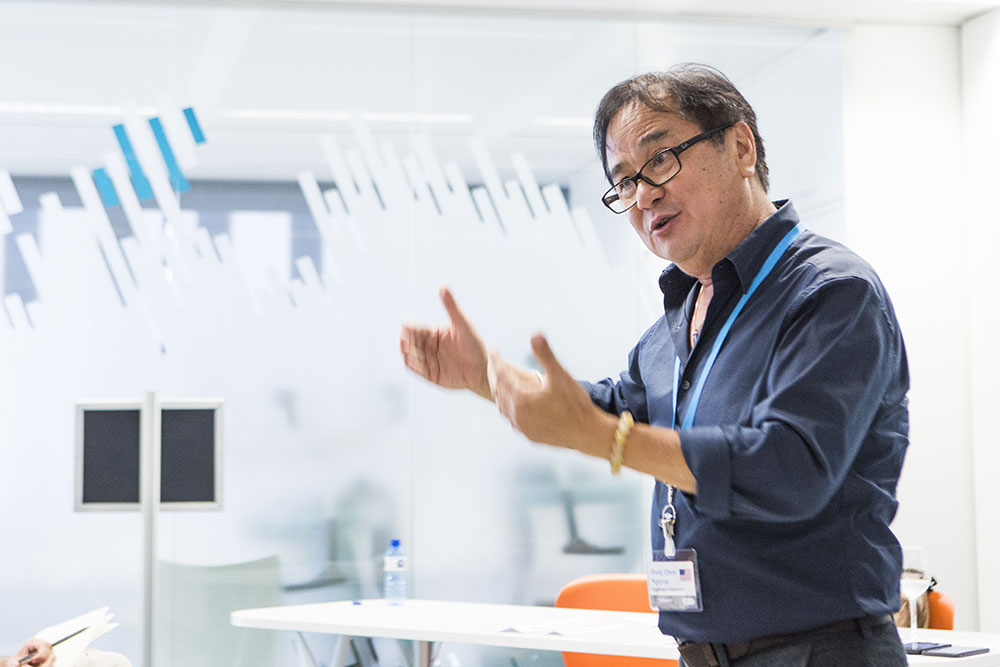
Hung Q. Nguyen, a revered figure in the domains of software testing, product development, and global business management, boasts an illustrious career spanning nearly four decades. As the Founder and CEO of LogiGear Corporation, a pioneering force in software testing and quality assurance solutions within the information technology sector, he has wielded significant influence, leaving an indelible mark on the industry. Hung's journey commenced at Cogswell Polytechnical College, where he earned his Bachelor of Science in Quality Assurance, laying the groundwork for his subsequent endeavors. Expanding his expertise, he pursued an Executive Program at Stanford Graduate School of Business, further honing his strategic acumen.
Hung embarked on a distinguished career path, contributing his talents to esteemed software and technology giants such as Electronic Arts, Palm Computing, 3Com, PowerUp, and Spinnaker Software. His entrepreneurial spirit eventually led him to establish LogiGear Corporation in 1994, situated in the heart of Silicon Valley, California. Here, he spearheaded the company's innovative initiatives in software testing, test automation, testing tool solutions, global sourcing, and testing education programs.
Through relentless dedication and unwavering commitment, Hung transformed LogiGear into a globally recognized enterprise software solutions provider, serving markets across the US, UK/EU, Japan, APAC, and Vietnam. His fervent pursuit of excellence established LogiGear as a benchmark in the software testing industry, earning international acclaim and recognition. This remarkable achievement serves as a testament to Hung's visionary leadership and diligent efforts.
In addition to his impactful role in software testing industry, Hung is a prolific author, renowned for his contributions to the field of software testing. He co-authored Testing Computer Software (Wiley), recognized by its publisher as the bestselling software testing book of all time, along with additional works including Testing Applications on the Web (Wiley) and Global Software Test Automation (Happy About), all published in multiple languages, solidifying his status as a thought-leader in the industry. Hung is also a co-founder and lifetime member of The Association for Software Testing (AST), a respected member of the Board of Advisors of Hue University, and a past member of the Board of Advisors of the Computing Department of the University of California Berkeley Extension. Hung authored and taught software testing courses at LogiGear University, and the University of California Berkeley and Santa Cruz Extension, and numerous universities across the country of Vietnam. He is a sought-after speaker at industry events and a contributor to key industry publications.
Hung's influence extends beyond the confines of technology, as he holds a special place within the Vietnamese business and information technology community. Continuously generating innovative ideas and opportunities, he contributes to the advancement of both the people and the economy of Vietnam. In essence, Hung Quoc Nguyen is not merely a leader; he is a visionary shaping the landscape of the software testing and IT world, and beyond.
With over 40 years in software testing, including co-founding a company that grew to a thousand engineers and helping establish global training organizations, I've seen it all. Yet, I'm still learning. AI has transformed this field faster than anything in decades. If a seasoned professional like me is still adapting, imagine the advantage you have starting fresh.